The Space in Between (2025)
The Space in Between is a participatory installation created in Australia that brings together cartography, intuition, and collective play. Using notebook collages and thousands of small ceramic pieces, the work invited participants to compose a shared image through observation, rhythm, and presence. Emerging from the intersection between a journey through Central Australia and a research process on social creativity, the project proposes art as a form of collective attention—capable of registering the lived moment and transforming it into a shared material trace.
Leer más...
The Space in Between is a participatory installation developed in March 2025 at the private art space of the Briggs–LARA Collection in Red Hill South, Australia. The work emerges from the intersection of two lines of inquiry that have shaped my recent practice: on one hand, the experience of a journey and residency in Central Australia in 2023; on the other, an ongoing research into collective creativity and the conditions that enable it in everyday life.
During my time in Australia, I was deeply moved by the relationship between landscape, memory, and knowledge. I became especially interested in the possibility of understanding forms of representation—such as maps or drawings—not as translations of territory, but as sensitive traces of lived experience in relation to others, to the land, and to time. This intuition converged with an ongoing question in my work: how to create situations in which art can operate as a form of shared, embodied, and free thinking.
From this intersection, the project took shape. For The Space in Between, I created three large-scale prints based on collages from my notebooks, including pages and notes from the journey. On these panels, a group of twelve participants was invited to intervene collectively by arranging approximately 3,000 small crescent-shaped ceramic pieces, manipulated with the tips of their fingers. The invitation was simple: to follow intuition, observe rhythms, respond to others, and allow the image to emerge through play.
The action was conceived as a shared experience of presence. Rather than composing a fixed artwork, the aim was to allow a provisional cartography of the moment to appear among those present. Each gesture—moving, repeating, bringing elements closer together, or leaving space—became part of a collective image shaped by attention, rhythm, and relation.
The conclusion of the action gave way to commensality: the act of eating and drinking together. The pieces were then fixed in the positions in which they had been left, forming a work composed of a triptych and a video of the performance. The work was acquired by the Briggs–LARA Collection of Latin American Art.
In this way, The Space in Between exists simultaneously as participatory installation and as a recorded collage: a work that understands creation as a collective process, and art as a way of giving sensory depth to the shared present.
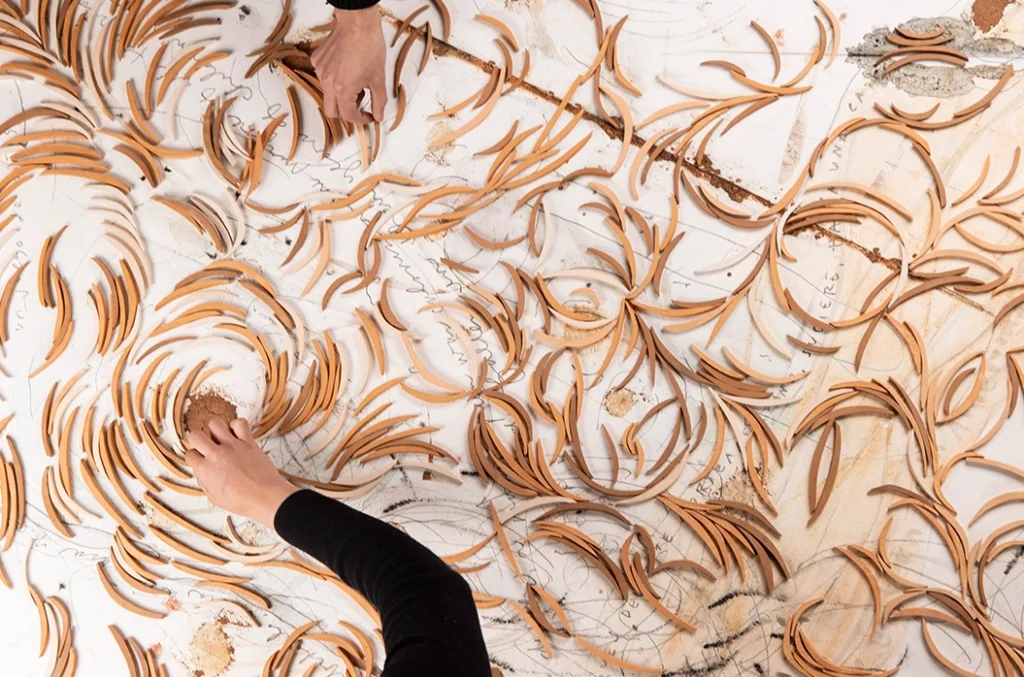
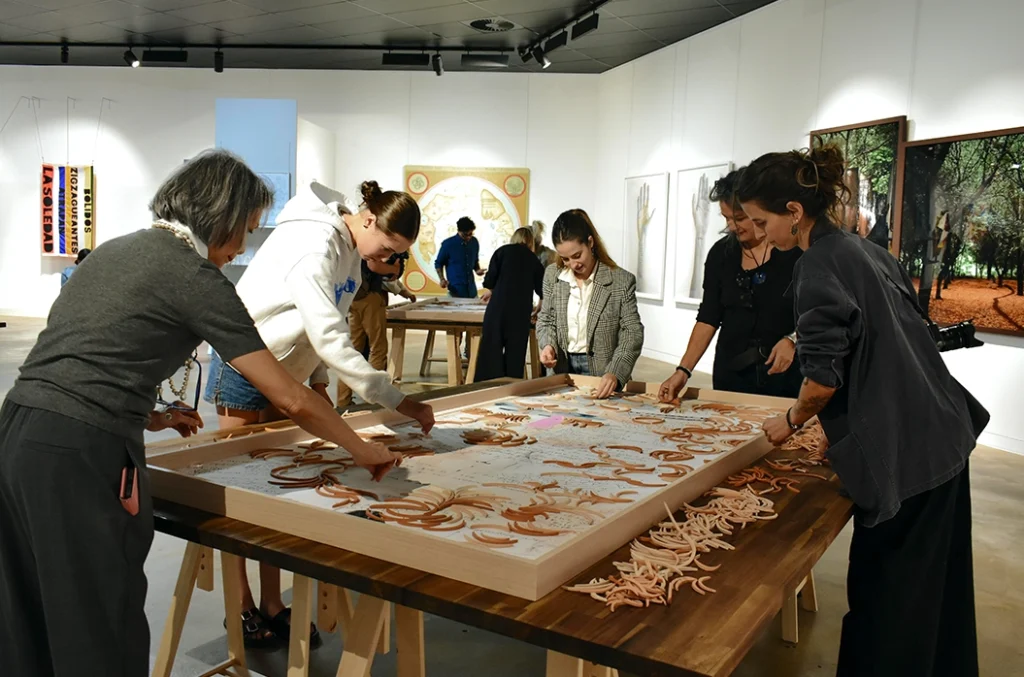
The Space in Between. A performance by Paula de Solminihac
Text by Carolina Castro Jorquera
When a deeper understanding of interconnection emerges in our lives, we begin to realise that nothing happens and no one exists in isolation. Everything is in relation to something else: it comes from somewhere or leads elsewhere, even if we do not always know where. Places — whether geographic, emotional, or symbolic — exist simultaneously, as they hold not only a spatial and temporal location but also a breadth of meanings, emotions, and intertwined stories. They are relational memories that transform the local into something ubiquitous, insofar as they transcend their own site.
Something similar occurs with thought when we recognise that ideas and knowledge emerge organically, shaped by moments of full presence — the now — and by situated knowledge — the here. Thinking thus becomes an embodied process of ongoing dialogue, shaped by the territories we inhabit, the relationships that sustain us, and the times that move through us. As anthropologist Eduardo Kohn suggests, thought is not an exclusively human faculty, but a capacity that unfolds within a web of living relations, where humans and non-humans alike participate in the creation of meaning.
From this perspective, art holds the potential to push at the edges in order to illuminate the spaces in between. In doing so, artworks do not merely represent what is visible, but activate a zone of latency: that which, while present, withdraws. As Georges Didi-Huberman writes, “what we see only lives in our eyes through what looks at us” (1992), reminding us that every image carries a dimension of absence that unsettles us and, at the same time, implicates us. The act of seeing places us within a relationship in which the visible is crossed by a constitutive void, by something that insists without fully revealing itself. At this threshold, artistic thinking sustains the tension of the indeterminate, making the “in between” a space of experience and knowledge.
The Space in Between — carried out in March 2025 at the private art space of the Briggs-Lara Collection of Latin American Art in Red Hill, Australia — proposes that we attend to these relational interstices, where individual authorship dissolves in the face of collective and cooperative making, highlighting the connections between thinking and doing. The work, created in situ, is activated through spectators who become makers: attentive bodies that allow themselves to be carried by a vital web. Each person is invited into a compositional game on a board previously designed by the artist, based on her sketchbooks and notes — loose fragments of thought — and a ceramic module which, by virtue of its form, may be arranged as branches and other vegetal shapes, as strands weaving braids, spirals, lunar phases, or other circular compositions.
In the process of composing each board, a form of thinking — and of making art — is revealed, where the “in between” does not occur only in the imaginary or reflective realm, or in the inner world of the one who makes or the one who observes, but becomes a present and tangible void, a fertile field. The concept of The Space in Between refers to reflections proposed by Indigenous Australian writer and thinker Tyson Yunkaporta, who in his book Sand Talk analyses global systems of thought through the Apalech clan practice of drawing in the sand, noting that true understanding lies not in fixed points but in the spaces between them — in the relational forces that connect and set things in motion.
Two years before creating this work, Paula de Solminihac had travelled to Central Australia to undertake a self-directed residency in the Northern Territory. During that journey, she met people and listened to their stories, and walked the sinuous geographies of Uluru and Kata Tjuṯa. More than a geographic displacement, the journey became inscribed as an experience of immersion in a territory that, although unfamiliar, resonated with creative processes long present in her artistic practice. Like those relational memories in which the present knots together past events into a new temporality, what she encountered and learned during the journey began to align with forms of thinking-making that had been simultaneously unfolding through earlier experiences. It was an experience that reinforced a premise already central to her practice: the need to create and care for knowledge collectively, and to value wandering — both physical and mental — as a way of weaving relationships.
In The Space in Between, this learning translated into an experience grounded in the understanding that a form of thinking cannot be separated from the body or from action. To play, there was only one instruction: be present. Thinking here did not mean analysing or judging, but responding to what emerged in common. It was a thinking that occurred in gesture, in pause, in tacit agreement, and in mutual attention. A thinking that accepts uncertainty and relinquishes total control, allowing itself to be affected by others — by the ceramics, the drawings — and by the festive, creative atmosphere that formed part of the same environment.
To be affected is to enter that web which expands us. It is to allow another’s rhythm to adjust our steps until a shared choreography emerges. In this sense, what was rehearsed there was the act of allowing oneself to be touched to respond. Like clay, which only becomes form when it accepts the pressure of hands, shared thinking emerged from that willingness to be transformed.
The game concluded when the group’s interest began to fade, when a collective agreement on the composition was reached, or when someone started thinking too much before acting. That threshold — when thought moves ahead of gesture — marked the closing and gave way to commensality: the act of eating and drinking together as a natural extension of being together. Rather than imposing a form onto matter, arranging the ceramic pieces on the boards involved following lines of force already present, latent, waiting to be revealed. The closing of the game thus functioned as a small ritual: not an arbitrary decision, but the recognition that a shared order had emerged and should be honoured, in the same way that a craftsperson allows the veins of a mineral to appear, and ritual reveals, within human territory, the structural relations of the universe.
More than offering a reflection on a work, this experience poses a broader question: what does it mean to think with others? To think with others is to recognise that thought does not belong entirely to us, but is formed in the movement between bodies, materials, territories, memories, and times. As Aymara sociologist Silvia Rivera Cusicanqui proposes, knowledge is not produced only in the abstract realm, but in everyday thinking-making — in the garden, in the kitchen — in simple gestures that sustain life in common. To think with others is to accept that knowledge is a collective wandering, sometimes circular, curvilinear, or linear, and that it is often built from the smallest things: a gesture, a game, a conversation, a joke, or a shared silence.
The forms of thought that run through The Space in Between — in dialogue with ancestral traditions — acknowledge the rich complexity of the web of life and propose a necessary shift in relation to the dominant logics of modern thought, and of art-making itself. It involves unlearning rigid thinking to open up to an organic way of thinking, one that is sensitive to the interdependence of life.
The resulting cartography does not represent a fixed territory, but a vibrant space. It is a fragile, situated record of a moment of shared life: a tapestry woven by many hands that speak to the power of the collective and the value of the present. In that “in between” — between people, ideas, memories, and materials — the work opens a question that resonates beyond the exhibition space: what if thinking was, above all, a collective act of care?
note: The original language of this text is Spanish. It was translated into English using Chat GPT.